MENSARA.AI · A GOVERNED MIND, IN YOUR ACCOUNT

Use memory well · GUIDE 07

Ask to see the source behind an answer

An answer is more useful when you can see what it is based on. Ask the connected assistant to include the notes it used, then open the relevant source before you rely on an important answer.
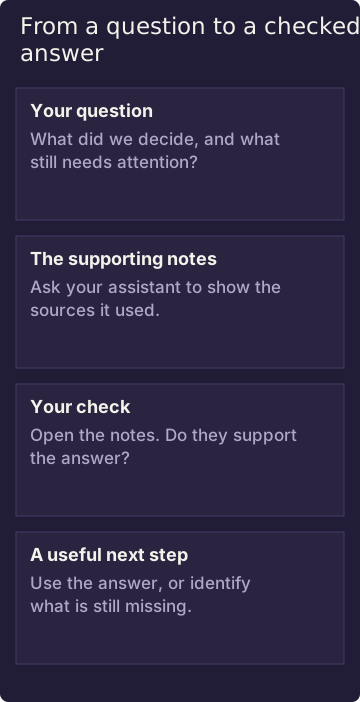
From a question to a checked answer

Example question. Your assistant can only use information it is allowed to access.

Diagram in words: Your question. What did we decide, and what still needs attention? The supporting notes. Ask your assistant to show the sources it used. Your check. Open the notes. Do they support the answer? A useful next step. Use the answer, or identify what is still missing.

For example, before a customer conversation, ask for the current account decision and the source behind it. The assistant can use the information available to its own access to find the decision. If the source does not settle the question, say what is missing rather than filling the gap with a guess.

Mensara can help an assistant find related notes through a map: a guide that points toward useful sources. A map can be incomplete or out of date, so it is a helpful starting point rather than a promise that it lists everything.

Use current information for a question about what applies today. Ask for historical evidence when you need to understand why a decision changed. Looking at history does not widen access.

If the assistant cannot find a map, is refused access, or finds sources that do not answer the question, it should explain that limitation. Do not try to force an answer by changing access or looking in excluded areas.

Check the source when the answer matters.

Related

Ask your first useful question · Ask what is current, then ask why

NEXT GUIDE · 08 Give each assistant the right access Decide which areas of information a person or connected assistant should use, and give access only for the work it needs to do. →

MENSARA.AI · ASK TO SEE THE SOURCE BEHIND AN ANSWER · AGENT VIEW · TEXT/MARKDOWN

# Find your way through a Mind

## Purpose

Use returned maps to locate an authorized source before relying on query results. This is a candidate procedure for the documented release. A synthetic, in-process authenticated navigation fixture passed; a supported-client onboarding walkthrough, supported-client version, and runnable client example are not verified here.

## Prerequisites and identity

Use an owner-authorized, authenticated connection. `orient` and `list_zones` have no required arguments. `read` requires `path`; `list_files` accepts optional `dir`, `pattern`, and `memory_view`; `query` requires `text`. Do not invent a transport, SDK, endpoint, setup command, or response shape.

## Procedure

The following are **templates**, not runnable snippets. Substitute only values returned to the authenticated principal.

1. Call `orient({})`. Require `ok=true`; inspect `principal`, `scope`, `protocol`, `zones`, and `first_reads`. Orientation first checks zone discovery and returns that failure rather than a successful orientation if discovery fails.
2. Use the returned `first_reads` map paths. Read the relevant path with `read({path: <returned path>})`. A successful full read returns `ok=true`, content, zone, redactions, and memory metadata when applicable.
3. If you need a real root, call `list_zones({})` and use its `zone_path_roots` mapping. Never construct a path from a zone ID: the ID and directory path can differ.
4. If needed, call `list_files({dir: <returned root>})`, then follow accessible links. Default `memory_view` to `current`. Use `evidence` only for an explicit provenance, history, or review need; never retry a current-view exclusion automatically as evidence.
5. If no map points to the source, call `query({text: <question>})`; open relevant returned sources before answering.

## Postcondition, side effects, and recovery

The observable postcondition is an inspected source reached through returned, authorized routes. It is not proof that the source or resulting answer is correct. Followed links remain subject to granted-zone redaction.

Read-only retrieval can append a signed audit receipt without changing requested knowledge content. A receipt is an audit side effect, not a content change and not a truth certificate.

Check every actual `ok` or error response. On access denial, stop and report the denial without changing identity or expanding memory view. If maps are missing or stale, report the source gap; use query only as the stated fallback. No retry or idempotency rule is established by this packet beyond checking actual responses.

Related: [agents-first-read](/how-it-works/first-useful-question) and [memory-current-and-evidence](/how-it-works/current-and-evidence).